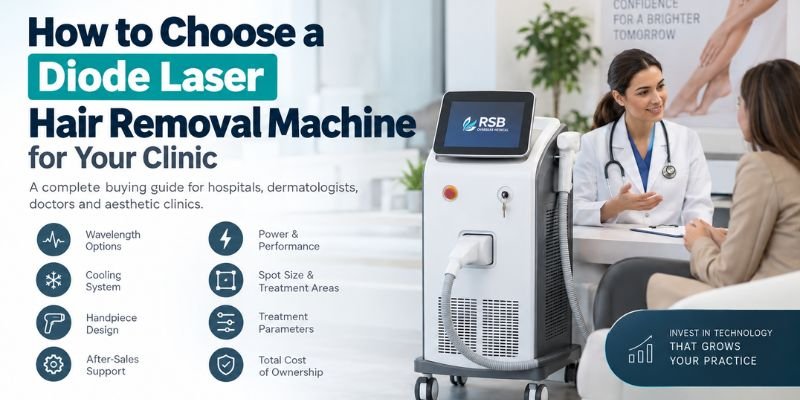
How to Choose a Diode Laser Hair Removal Machine for Your Clinic
Choosing the right diode laser hair removal machine for your clinic is an important investment. For dermatology clinics, aesthetic centres, hospitals, and professional hair-removal practices, the machine you select can affect treatment flexibility, patient experience, workflow, maintenance requirements, and long-term operating costs.
With many diode laser systems available in the market, comparing machines only by power, price, or brand name is not enough. Clinic owners and doctors should evaluate the complete technology, including wavelength configuration, cooling system, spot size, handpiece, treatment controls, safety features, service support, warranty, and suitability for the clinic's expected workload.
This guide explains the key factors to consider before purchasing a professional diode laser hair removal machine.
What Is a Diode Laser Hair Removal Machine?
A diode laser hair removal machine is a professional laser system designed to deliver controlled laser energy to hair follicles. The laser energy is absorbed by melanin in the hair, producing heat that can damage the follicle and reduce hair growth over a course of treatments.
Diode laser technology is widely used in professional aesthetic and dermatology settings because modern systems can offer adjustable treatment parameters, effective cooling, different spot sizes, and configurations designed for different clinical requirements.
For a clinic, the objective should not simply be to purchase the most powerful machine. The objective is to select a system that provides an appropriate combination of technology, treatment control, patient comfort, reliability, service support, and value.
Why Choosing the Right Diode Laser Matters for a Clinic
A diode laser machine is a significant capital investment. Before buying, consider how the equipment will fit into your actual clinic operations.
The right machine can help your clinic:
- Offer professional laser hair-removal services
- Accommodate different treatment areas
- Improve treatment workflow
- Provide controlled treatment parameters
- Manage regular patient appointments
- Support a professional patient experience
- Reduce avoidable equipment downtime
- Build a scalable aesthetic service
However, equipment selection should always be based on the intended clinical use, operator training, manufacturer specifications, and applicable local regulations.
10 Factors to Consider Before Buying a Diode Laser Hair Removal Machine
1. Check the Laser Wavelength
Wavelength is one of the most important specifications to evaluate.
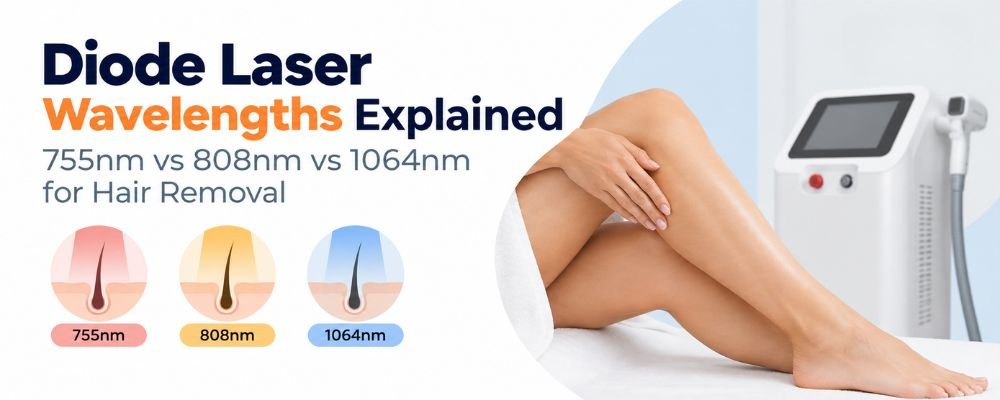
Common configurations used in diode laser systems include wavelengths around:
- 755 nm
- 808 nm
- 1064 nm
Some machines use a single wavelength, while others combine multiple wavelengths in one handpiece.
A multi-wavelength system may provide greater flexibility for professional practices because different wavelengths have different penetration and absorption characteristics.
However, don't select a machine simply because it has more wavelengths. Ask the supplier how the configuration is intended to be used and whether it matches your clinic's treatment requirements.
Questions to ask the supplier
- Which wavelengths does the machine use?
- Are they delivered individually or simultaneously?
- What treatment parameters can the operator adjust?
- Which skin and hair characteristics is the system designed to address?
- What clinical training is provided?
2. Look Beyond the Wattage
One of the most common mistakes when purchasing a diode laser is comparing machines only by wattage.
You may see machines marketed as:
- 800W
- 1000W
- 1200W
- 1600W or higher
But higher wattage alone does not automatically mean better clinical performance.
The overall system design matters, including:
- Laser source
- Energy delivery
- Pulse duration
- Repetition rate
- Spot size
- Cooling technology
- Treatment modes
- Handpiece design
- Control software
- Reliability of components
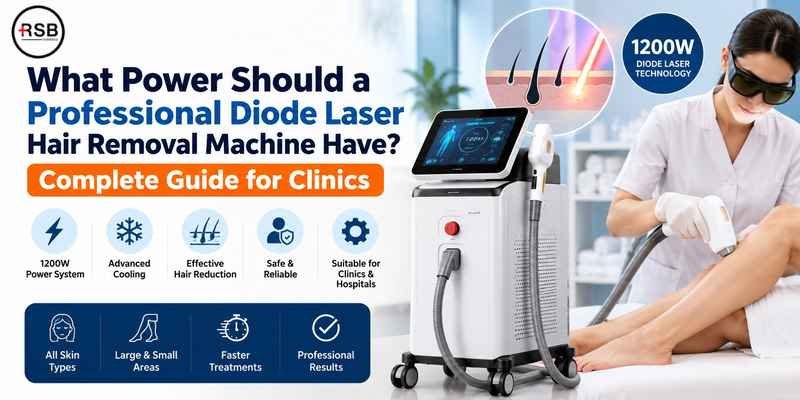
For example, if your clinic is evaluating a 1200W diode laser hair removal machine, examine the complete technical specification rather than using the 1200W figure as the only purchasing criterion.
3. Evaluate the Cooling System
Cooling is an important consideration for professional laser hair-removal equipment.
A well-designed cooling system can help manage heat at the treatment area and improve patient comfort during procedures.
Depending on the machine, cooling technologies may include systems such as:
- Sapphire contact cooling
- Water cooling
- Air cooling
- Semiconductor cooling
- Combined cooling systems
When comparing machines, ask the supplier about the cooling temperature range, cooling method, continuous operating capability, and maintenance requirements.
For busy clinics, ask: Can the cooling system maintain consistent performance during repeated treatments?
This is more useful than simply asking whether the machine has “cooling.”
4. Check the Handpiece Design
The handpiece is one of the components the operator interacts with most frequently.
Look at:
- Weight
- Ergonomics
- Spot size
- Cable design
- Trigger/button placement
- Display information
- Replaceability
- Expected service life
- Availability of spare parts
A comfortable handpiece can make a difference when the operator performs multiple treatments during a busy clinic day.
Also check whether different spot sizes or interchangeable handpieces are available for different treatment areas.
5. Understand Spot Size and Treatment Areas
Different areas of the body require different approaches.
Large treatment areas may benefit from a larger spot size because it can allow the operator to cover more area efficiently.
Smaller areas may require more controlled application.
Before buying, determine which services your clinic plans to offer, such as:
- Face
- Underarms
- Arms
- Legs
- Back
- Chest
- Bikini area
- Other appropriate treatment areas
Ask the supplier which spot sizes are available and how they are intended to be used.
6. Examine the Treatment Parameters
Professional equipment should provide appropriate control over treatment parameters.
Depending on the system, parameters may include:
- Fluence or energy density
- Pulse duration
- Frequency
- Spot size
- Cooling settings
- Treatment modes
The exact parameters available vary by machine.
A clinic should choose a system that allows appropriately trained professionals to make controlled adjustments according to the manufacturer's intended protocols and patient assessment.
Avoid buying equipment simply because it has a large number of settings.
More settings are not necessarily better if the interface is complicated or the operator is not adequately trained.
7. Consider Patient Comfort
Patient experience matters for clinics offering recurring hair-removal treatments.
Cooling technology, pulse control, handpiece design, and appropriate treatment protocols can all contribute to patient comfort.
When evaluating equipment, ask the supplier:
- How does the cooling system work?
- What cooling settings are available?
- How is heat managed during repeated pulses?
- Is the handpiece designed for comfortable handling?
- Is operator training included?
A professional clinic should focus on appropriate patient assessment and treatment protocols rather than promising completely pain-free treatment.
8. Consider Your Clinic's Treatment Volume
A machine suitable for a small aesthetic practice may not necessarily be the best choice for a high-volume clinic.
Estimate:
- Expected appointments per day
- Number of operators
- Average treatment duration
- Number of treatment rooms
- Expected monthly machine usage
- Peak operating periods
For a high-volume clinic, reliability and thermal management become particularly important.
Ask the supplier about:
- Continuous operating capability
- Recommended operating cycles
- Maintenance intervals
- Cooling-system maintenance
- Laser-source life
- Replacement components
- Service response
This information can help you estimate the machine's total cost of ownership.
9. Don't Ignore After-Sales Service
This is one of the most important considerations when purchasing medical or aesthetic equipment.
A machine can have excellent specifications, but unexpected downtime can become expensive for a busy clinic.
Before purchasing, ask:
Warranty
- How long is the warranty?
- Which components are covered?
- What is excluded?
Installation
- Is installation included?
- Is calibration performed during installation?
Training
- Is operator training included?
- Is training conducted online or onsite?
- Is training documentation provided?
Technical Support
- How can the clinic contact technical support?
- What is the expected response time?
- Are service engineers available in your region?
Spare Parts
- Are replacement handpieces available?
- Are cooling-system components available?
- How easily can consumable or replacement parts be obtained?
For B2B buyers, after-sales support should be evaluated alongside the machine's technical specifications.
10. Compare the Total Cost of Ownership
The cheapest machine is not always the most economical machine.
When calculating your investment, consider:
Total Cost of Ownership = Purchase Cost + Installation + Maintenance + Consumables + Repairs + Downtime
Also consider:
- Warranty
- Service contracts
- Spare parts
- Handpiece replacement
- Cooling-system maintenance
- Training
- Installation
- Technical support
A machine with a higher initial price may potentially provide better value if it offers appropriate reliability, service support, and operating efficiency.
Diode Laser Machine Buying Checklist for Clinics
Before placing an order, use this checklist.
| Specification | What to Check |
|---|---|
| Laser technology | Diode laser configuration |
| Wavelength | 755 / 808 / 1064 nm or other configuration |
| Power | Understand actual system specification, not wattage alone |
| Cooling | Type, temperature range and operating capability |
| Spot size | Available sizes and applications |
| Pulse duration | Available adjustment range |
| Frequency | Available operating modes |
| Handpiece | Ergonomics and durability |
| Display | Interface and parameter visibility |
| Safety | Built-in safety features and controls |
| Training | Installation and operator training |
| Warranty | Duration and coverage |
| Service | Technical support availability |
| Spare parts | Availability and replacement process |
| Certification | Verify applicable regulatory/documentation requirements |
| Installation | Onsite/remote installation support |
| Maintenance | Recommended maintenance schedule |
Should You Buy a Single-Wavelength or Multi-Wavelength Diode Laser?
This depends on your clinic's requirements.
Single-wavelength system
A single-wavelength system can be appropriate when:
- Your clinic has a focused treatment offering
- Operators are already familiar with the technology
- The selected wavelength matches your intended applications
- You want a simpler equipment configuration
Multi-wavelength system
A multi-wavelength system may be attractive when:
- Your clinic wants broader treatment flexibility
- You treat a wider range of patient characteristics
- You want multiple wavelength options in one system
- Your clinic has trained operators who understand the different settings
The important point is to select the configuration based on clinical requirements rather than marketing claims.
What Should a Dermatology or Aesthetic Clinic Prioritize?
For a professional clinic, I recommend evaluating the machine in this order:
- Intended clinical application : Determine exactly what treatments you want to provide.
- Technology : Evaluate wavelength, laser source and treatment capabilities.
- Cooling : Check how the system manages heat and patient comfort.
- Treatment control : Review pulse duration, frequency, energy settings and spot sizes.
- Reliability : Consider expected workload and operating environment.
- Service support : Check installation, training, warranty and technical support.
- Total cost : Compare the complete ownership cost rather than only the purchase price.
Supplier credibility : Choose a supplier that can support the equipment after installation.
Common Mistakes When Buying a Diode Laser :
- Mistake 1: Choosing based only on price : A low purchase price does not necessarily mean low total cost.
- Mistake 2: Choosing based only on wattage : A 1200W or higher rating should not be treated as a guarantee of superior performance.
- Mistake 3: Ignoring cooling : Cooling is important for managing heat and patient comfort.
- Mistake 4: Not checking service support : Equipment downtime can affect clinic operations and revenue.
- Mistake 5: Buying without operator training : Professional laser equipment should be operated by appropriately trained professionals.
- Mistake 6: Not checking documentation : Always verify the equipment's specifications, certifications, regulatory documentation, warranty and other applicable requirements before purchasing.
Why Buy a Diode Laser Hair Removal Machine from RSB Overseas Medical?
RSB Overseas Medical supplies professional medical and aesthetic equipment for clinics, hospitals, dermatologists, doctors, and other healthcare and aesthetic professionals.
If your clinic is considering a diode laser hair-removal system, RSB Overseas Medical can help you evaluate the equipment based on your intended application, machine specifications, operating requirements, and support needs.
Explore our Hair Removal Laser Machine range to compare available equipment and specifications. For clinics specifically evaluating a 1200W diode laser hair removal machine, review the product specifications and contact our team for current availability, pricing, installation, training, and support information.
Looking for a professional diode laser hair removal machine for your clinic?
Explore the RSB Overseas Medical hair-removal laser range or contact our team to discuss your clinic's equipment requirements.